Showing posts with label Adsense. Show all posts
Showing posts with label Adsense. Show all posts
Wednesday, 19 November 2014
 Why do you need paying for Keywords when you can have it for free here... Let get started, In this post I am giving a list of highest paying keywords to get higher CPC rate for Google Adsense Business. If you work as a Publisher in Google Adsense, then you will always try to get increase in your earning through valid clicks. Many of the publishers get a good CTR rate, but still they can't make much money from their blog and product.
I mean they get a very good number valid clicks for Adsense but still the estimated earning is too low. For an example, some peoples get 50 clicks in a day and still estimated earning remains $0.82! This is a really unexpected and annoying earning. Though, I can say, It really not your fault for this much low earning. In actual, lower rate of CPC i.e. Cost Per Click is responsible for this low earning. You must have noticed that Google AdSense shows relevant Advertises according to your post contents. This means the advertises show on a website is related to the keywords used in a particular post of a blog. Cost Per Click is related with these keywords. Google will not pay you an average earning rate for these clicks. Sometimes you can get $2.5 for a single click, and sometimes they will not give you a combined $2.5 for 30 clicks. CPC rate depends on the Advertises that people have clicked. If a visitor clicked on a high paying advertise, then you will surely get a good money. As I stated in the beginning of this post, Ads are displayed in accordance with the keywords of your content. If you have entered higher paying keywords in your post then you will get a high rate of CPC. So here in this post, I going to share 70 high paying keywords for you AdSense advertises. It is clear that all the keywords given here will not be suitable for your niche of your blog/application. Just try and find the keywords that are related to your blog and website and push hard to use them into your blog post.
MESOTHELIOMA LAW FIRM
DONATE CARS IN MA
DONATE YOUR CAR
SACRAMENTO
HOW TO DONATE A CAR IN CALIFORNIA SELL ANNUITY PAYMENT
DONATE CAR TO CHARITY CALIFORNIA DONATE CAR FOR TAX CREDIT
DONATE YOUR CAR FOR KIDS ASBESTOS
LAWYERS STRUCTURED
ANNUITY SETTLEMENT
ANNUITY SETTLEMENTS HOLLAND MICHIGAN COLLEGE ONLINE
MOTOR INSURANCE
QUOTES ONLINE COLLEDGES PAPERPORT PROMOTIONAL CODE ONLINECLASSES
WORLD TRADE CENTER
FOOTAGE MASSAGE SCHOOL
DALLAS TEXAS PSYCHIC FOR FREE DONATE OLD CARS TO CHARITY
LOW CREDIT
LINE CREDIT CARDS
DALLAS MESOTHELIOMA ATTORNEYS CAR INSURANCE
QUOTES COLORADO NUNAVUT CULTURE DAYTON
FREIGHT LINES HARDDRIVE
DATA RECOVERY SERVICES
DONATE A CAR IN MARYLAND
MOTO REPLACEMENTS
CHEAP DOMAIN REGISTRATION HOSTING
DONATING A CAR IN MARYLAND DONATE CARS ILLINOIS
CRIMINAL DEFENSE ATTORNEYS FLORIDA BEST CRIMINAL LAWYER IN ARIZONA
LIFE INSURANCE CO LINCOLN
CAR INSURANCE QUOTES MN
DONATE YOUR CAR FOR MONEY CHEAP AUTO INSURANCE IN VA MET AUTO CAR INSURANCE IN SOUTH DAKOTA
EMAIL BULK SERVICE
WEBEX COSTS
CHEAP CAR INSURANCE FOR LADIES CHEAP CAR INSURANCE IN VIRGINIA REGISTER FREE DOMAINS
BETTER CONFERENCING CALL FUTURISTIC ARCHITECTURE MORTGAGE ADVISER
CAR INSURANCE QUOTES
ASBESTOS LUNG CANCER INJURY LAWYERS FORENSICS
ONLINE COURSE
HOME PHONE INTERNET BUNDLE DONATING USED CARS TO CHARITY PHD IN COUNSELING EDUCATION NEUSON CAR INSURANCE QUOTES
PA ROYALTY
FREE IMAGES STOCK
CAR DONATE
VIRTUAL DATA ROOMS
AUTOMOBILE ACCIDENT ATTORNEY AUTO ACCIDENT ATTORNEY CAR ACCIDENT LAWYERS
DATA RECOVERY
RAID MOTOR INSURANCE QUOTES PERSONAL INJURY LAWYER PERSONAL INJURY LAW FIRM ONLINE CRIMINAL JUSTICE DEGREE CAR INSURANCE COMPANIES BUSINESS VOIP SOLUTIONS
Others Top highest keywords
1. Structured settlements
2. Mesothelioma
3. Acne
4. Life Insurance
5. Asbestos
6. Bextra
7. Bankruptcy
8. Car Insurance
9. Dental Plan
10. Private Jet
11. Debt Consolidatio
12. Credit Card
13. Canadian Pharmac
14. Online Tradin
15. Equity Line Credit
16. Loans
17. Mortgages
18. Pay Day Loans
19. Cash Advance
20. Equity Loans
21. Reduce Debt
22. Refinance
23. Jet Charter
24. Rehab
25. Wrongful death
26. Legal Advice
27. Taxes
28. Investing
29. Bonds
30. Vixx
31. IRA Rollover
32. Refinance Quotes
33. Adult Education
34. Distance Learning
35. Alcohol Treatment
36. Depression
37. Drug Rehab
38. Extra Money
39. Cell Phone Plans
40. Calling Cards
41. VOIP
42. Weight Loss
43. Homeowner’s Insurance
44. Rewards Cards
45. Spam Filter
46. Lasik
47. Facelift
48. Teeth Whitening
49. Annuity
50. Anti Virus Protection
51. Adult Diaper
52. Free Credit Report
53. Credit Score
54. Satellite
55. Anti Spam Software
56. Dedicated Hosting
57. Domain Name
58. Need Money
59. Bachelor Degree
60. Master Degree
61. Doctorate Degree
62. Work at Home
63. Quick Book
64. Spyware
65. Eloan
66. Malpractice Lawyer
67. Lenox China
68. Cancer
69. Payperclick
70. Personal Injury Attorney
71. Lexington Law
72. Video Conferencing
73. Transfer Money
74. Windstar Cruise
75. Casinos Online
76. Laptop Computer
77. Online Banking
78. Borrow Money
79. Low Interest Credit Cards
80. Personal Domain Name
81. Cellular Phone Rental
82. Internet Broker
83. Term Life
84. Cheap Hosting
85. University Degrees Online
86. Online Marketing
87. Consolidate
88. Business Credit
89. Web Host
90. Web Designing
91. Death Insurance
92. Yellow Page Advertising
93. Travel Insurance
94. Register Domain
95. Credit Counseling
96. Email Hosting
97. Trans Union
98. Consumer Credit
99. Blue Cross
100. Helpdesk Software
Stay tuned for more info here...
Tuesday, 18 November 2014
A common worry for site owners is that of duplicate content. This worry can develop over time as your site gets bigger you might begin to forget how many pages are on your site and which elements are duplicated. Moreover, this worry seems to stem from the fact that SEO’s are unsure as to what exactly is duplicate content.
Duplicate content is a big issue which affects both SEO and content marketing. Unique content for SEO Search engines want to filter out duplicative content – this means they don’t want to show things that are the same. Search engines don’t want to show a set of results where all the rankings show the same article which contains the same content, photos etc. Search engines like Google know that users won’t like having a whole list of sites with the same content, which completely makes sense. However, it does leave us asking, how unique should I be with my content? Unique content for content marketing Firstly let’s explain the term unique content; this refers to the unique material on a page. When you break it down and exclude the likes of footers, ads and sidebars etc., this leaves a low percentage of page space which contains text. If you’re worried about having pages with light content, don’t worry about it too much as this is a common occurrence with many sites. What really matters is the unique value of the content which fills this space. Duplication applies to internal and external sources Internal – engines will try to ignore this if it’s occurring in small and subtle amounts happening here and there. There’s a reason for this, such as search engines accommodating for different versions of your pages such as mobile and print etc. External – you can include text from other sources but don’t overstep the mark here. By all means take a paragraph from Wikipedia or cite a blogger including some of their phrases or even use a YouTube video to supplement your content. It’s not duplicative as long as you’re adding unique value to this. This means you need to add your own insights into the piece, whether it be unique photo content or unique insider tips and comments. If you’re not adding value then it’s not unique enough for the search engines and why would it be if all you’ve done is a copy and paste. One more thing, a lot of SEO’s discuss a magical % of unique content that your pages should have. I’m sure I’ve even seen tools which assess your pages and give you a value of their uniqueness compared to this mythical perfect score. Well, it truly is a myth there’s no perfect percentage score that your pages should have. For Google this doesn’t exist so why should it exist for SEO’s? The algorithms are far more sophisticated than a specific percentage for unique content. Many different aspects are checked and scrutinised to deliver the best possible search results such as backlinks, comments, and social signals even domain authority can also play a role here. Finally, please remember that due to the Panda update duplicative content in one area of your site can harm your whole site. If you’re nervous about this you can robots.txt this content so robots don’t crawl it and you can make use of the rel canonical tag.
Duplicate content is a big issue which affects both SEO and content marketing. Unique content for SEO Search engines want to filter out duplicative content – this means they don’t want to show things that are the same. Search engines don’t want to show a set of results where all the rankings show the same article which contains the same content, photos etc. Search engines like Google know that users won’t like having a whole list of sites with the same content, which completely makes sense. However, it does leave us asking, how unique should I be with my content? Unique content for content marketing Firstly let’s explain the term unique content; this refers to the unique material on a page. When you break it down and exclude the likes of footers, ads and sidebars etc., this leaves a low percentage of page space which contains text. If you’re worried about having pages with light content, don’t worry about it too much as this is a common occurrence with many sites. What really matters is the unique value of the content which fills this space. Duplication applies to internal and external sources Internal – engines will try to ignore this if it’s occurring in small and subtle amounts happening here and there. There’s a reason for this, such as search engines accommodating for different versions of your pages such as mobile and print etc. External – you can include text from other sources but don’t overstep the mark here. By all means take a paragraph from Wikipedia or cite a blogger including some of their phrases or even use a YouTube video to supplement your content. It’s not duplicative as long as you’re adding unique value to this. This means you need to add your own insights into the piece, whether it be unique photo content or unique insider tips and comments. If you’re not adding value then it’s not unique enough for the search engines and why would it be if all you’ve done is a copy and paste. One more thing, a lot of SEO’s discuss a magical % of unique content that your pages should have. I’m sure I’ve even seen tools which assess your pages and give you a value of their uniqueness compared to this mythical perfect score. Well, it truly is a myth there’s no perfect percentage score that your pages should have. For Google this doesn’t exist so why should it exist for SEO’s? The algorithms are far more sophisticated than a specific percentage for unique content. Many different aspects are checked and scrutinised to deliver the best possible search results such as backlinks, comments, and social signals even domain authority can also play a role here. Finally, please remember that due to the Panda update duplicative content in one area of your site can harm your whole site. If you’re nervous about this you can robots.txt this content so robots don’t crawl it and you can make use of the rel canonical tag.
Saturday, 15 November 2014
If you are using Google adsense in your blog as
monetizing method, then you must be aware of high
paying keywords. Every keyword is not paying the
same amount for each clicks. Therefor, it’s
advisable to find and insert high paying keywords in
your blog or posts. Let me show in this post how to
find high paying keywords for adsense.
The simple and free tool we can use for this
purpose is
, Google keyword tool. It’s a free product
for adsense users. Google keyword tool is not
designed for publishers like us, it’s designed for
advertisers who are looking to advertise through
Google adwords. But, as publishers and bloggers
we can utilize this product to find the high paying
keyword for adsense.
Ok, lets go with an example.
If you are planning to write a post about
“Webhosting”, go to Google keyword tools and
enter the keyword phrase.
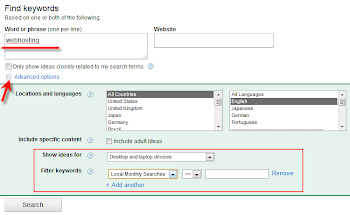
Some filter options are available under Advanced options.
Once you press the Search button, it will list out the keywords related to search term. The fields are
easy to understand.
If you still can’t find the very suitable keyword for ‘Webhosting’, this can be filtered by Match Types in left side.
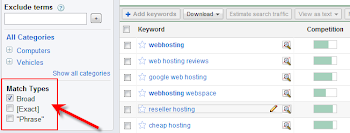
Remove the ‘Board’ type and select either Exact or
Phrase .
‘Exact’ will bring the more relevant keyword for
your search term.
“Phrase” will bring the same search term text in
keywords.
But, we are here to get the high paying keyword
related to ‘Webhosting’ , so first do not not change any filter types under Match Types.
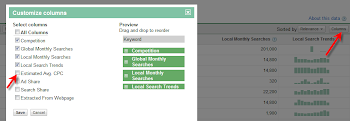
The first result screen in Google keyword tool doesn’t show the Estimated Avg CPC ( which decides the value of keyword), we have to enable
this column by doing following steps.
Click on columns in right side of menu bar and select the Estimated Avg CPC.
What is Estimated Avg CPC?
As I said earlier, this tool is for advertisers. If I’m a
advertiser and want to advertise my product or
service through Google adwords, then I have to
select some keyword for each ad slots.
For example if my main keyword for this ad campaign is ‘webhosting’, then I have to bid (pay) more than Estimated Avg CPC for ‘webhosting’ keyword for a click to beat the competitors. So, my ads will be displayed in Google’s first search result (Search results related to webhosting), top blogs and blog posts related to ‘webhosting’.
So, obviously high Estimated Avg CPC means, high pay out for publishers also if we get the correct ads.
Now click on Estimated Avg CPC column to sort the filed.
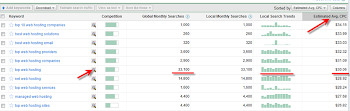
Here you have to understand something clearly and
select the correct keyword.
Competition
Again this is not for us, this means the competition
between advertisers, there are more advertisers
bidding and advertising on this keyword.
If you want to find the competition for specific
keyword as a blogger, then just simply type this
keyword in Google and see the number of search
results found.
The arrow mark I showed next to Competition
column will give more ideas on this keyword about
trend and history from Google Insights. It’s another
handy tool for bloggers to find out the good keyword
and niche for a blog or post.
Global and Local Searches
This should be considered too. If you target only
high paying keyword but no one is searching that,
then its pointless and you can’t make any money
from adsense.
You should be very smart to select the correct high
paying keyword. If you select the high searched
keyword, then it will have more competition. Getting
in to Google’s first page for thisj keyword is not at
all an easy task.
In this example, I would prefer to write about ‘ Top
web hosting’ . Its having high paying keyword with good search history.
But unfortunately, its having more competition with 140,000,000 results (as of today). so I don’t think I can beat them.

In this case, I follow my own way to utilize this high paying keyword to monetize my blog posts with adsense.
I will write that technique in coming days.
Feel free to drop your comments and suggestion about these steps.
Sources: www.dailyblogmoney.com/how-to-find-high-paying-keyword-for-adsense
monetizing method, then you must be aware of high
paying keywords. Every keyword is not paying the
same amount for each clicks. Therefor, it’s
advisable to find and insert high paying keywords in
your blog or posts. Let me show in this post how to
find high paying keywords for adsense.
The simple and free tool we can use for this
purpose is
, Google keyword tool. It’s a free product
for adsense users. Google keyword tool is not
designed for publishers like us, it’s designed for
advertisers who are looking to advertise through
Google adwords. But, as publishers and bloggers
we can utilize this product to find the high paying
keyword for adsense.
Ok, lets go with an example.
If you are planning to write a post about
“Webhosting”, go to Google keyword tools and
enter the keyword phrase.

Some filter options are available under Advanced options.
Once you press the Search button, it will list out the keywords related to search term. The fields are
easy to understand.
If you still can’t find the very suitable keyword for ‘Webhosting’, this can be filtered by Match Types in left side.

Remove the ‘Board’ type and select either Exact or
Phrase .
‘Exact’ will bring the more relevant keyword for
your search term.
“Phrase” will bring the same search term text in
keywords.
But, we are here to get the high paying keyword
related to ‘Webhosting’ , so first do not not change any filter types under Match Types.
The first result screen in Google keyword tool doesn’t show the Estimated Avg CPC ( which decides the value of keyword), we have to enable
this column by doing following steps.
Click on columns in right side of menu bar and select the Estimated Avg CPC.

What is Estimated Avg CPC?
As I said earlier, this tool is for advertisers. If I’m a
advertiser and want to advertise my product or
service through Google adwords, then I have to
select some keyword for each ad slots.
For example if my main keyword for this ad campaign is ‘webhosting’, then I have to bid (pay) more than Estimated Avg CPC for ‘webhosting’ keyword for a click to beat the competitors. So, my ads will be displayed in Google’s first search result (Search results related to webhosting), top blogs and blog posts related to ‘webhosting’.
So, obviously high Estimated Avg CPC means, high pay out for publishers also if we get the correct ads.
Now click on Estimated Avg CPC column to sort the filed.

Here you have to understand something clearly and
select the correct keyword.
Competition
Again this is not for us, this means the competition
between advertisers, there are more advertisers
bidding and advertising on this keyword.
If you want to find the competition for specific
keyword as a blogger, then just simply type this
keyword in Google and see the number of search
results found.
The arrow mark I showed next to Competition
column will give more ideas on this keyword about
trend and history from Google Insights. It’s another
handy tool for bloggers to find out the good keyword
and niche for a blog or post.
Global and Local Searches
This should be considered too. If you target only
high paying keyword but no one is searching that,
then its pointless and you can’t make any money
from adsense.
You should be very smart to select the correct high
paying keyword. If you select the high searched
keyword, then it will have more competition. Getting
in to Google’s first page for thisj keyword is not at
all an easy task.
In this example, I would prefer to write about ‘ Top
web hosting’ . Its having high paying keyword with good search history.
But unfortunately, its having more competition with 140,000,000 results (as of today). so I don’t think I can beat them.

In this case, I follow my own way to utilize this high paying keyword to monetize my blog posts with adsense.
I will write that technique in coming days.
Feel free to drop your comments and suggestion about these steps.
Sources: www.dailyblogmoney.com/how-to-find-high-paying-keyword-for-adsense
Search Engine Optimization companies are making a fortune by doing the menial work that is overlooked by many designers. It is ridiculously easy to do most of the work done by most SEO companies, all you have to do is create good habits.
There are 9 main points you should focus on:
• Keywords
• URL Text
There are 9 main points you should focus on:
• Keywords
• URL Text
• Description, Meta tags
• Title tags
• Image Names
• ALT tags
• Heading tags
• Content
• Hyperlinks
The focus of these 8 steps is to load your pages with as many "keywords" as possible. Keywords
Keywords are the most important aspect of good SEO, this is where you tell the Search Engines what
your site is about. Search Engines use an algorithm to determine the "Keyword Density" of your site, this
formula is: Total Words ÷ Keywords= Keyword Density
Use this formula on your competitors web site and see how they score, then aim to beat that score.
Choose keywords that best relate to the information, products or services that you are offering. For instance, if I am designing a site about "Web
Design", I want my site to include the words "Web Design" as many times as possible.
However, most people don't just search for just one word, they type phrases, so you should consider
the phrases that best suit your sites target market.
For example, if I am creating a site about "Web Design" in New Orleans, I would include "New Orleans web design" in my keywords. Another way
around this is to not separate my keywords with commas, just use spaces, and the Search Engines
will make the phrases for you. The most important thing to remember is that the content of each page
is different, so only use keywords pertaining to that page.
URL Text
When you name a new page you have the option to call it anything you could possibly think of, why not
se a keyword? After all, the URL address is the first things a search engine comes across when
indexing your pages. You have to remember content doesn't come easy to everyone, so you gotta slip in
your keywords when the process gives you an easy one.
Description Meta tags
These tags are dwindling in importance since Search Engines are now looking at content, but every little bit counts.
Optimize your meta tags to match your content, products, and services, and the Search Engines
that still look at meta data will reward your efforts.
Title Tags
Title tags are the tags that tell the Search Engine the title, or formal description of the document or
page. This is the word or phrase that is seen at the top of the browser window. The most important rule
about title tags is, don't put anything in the title tags but keywords. Once again this is an easy time to
slip in your keywords, so don't miss out.
Image Names
As I said before, content doesn't come easy to everyone, so slip in your keywords whenever possible, this applies to image names. If you are
saving a picture of a guy working on a computer for your web design web site, don't call it "some_dude.jpg", call it "web_site_design.jpg". The Search
engine will look at the code for the site and see the image pertains to the content of the site and this will be another relevant element on that particular page. You have to take the easy ones when you are given a chance.
ALT tags
Alt tags are keywords that you can attach to images, giving more weight to the image since Search Engines can't analyze the content of the
image itself. Here is a chance to slip in more keywords without writing great content, use it.
Heading tags
Heading tags are associated with the bold font that leads into a section of text. Like this:
Web Design
Web Design Inc. offers custom web site designs...
Your heading tags should only be keywords, and should be presented in the order that your Meta tags follow.
H1= first meta tag, H2= second meta tag...
Try to utilize all 6 heading tags on each page to ensure maximum page optimization.
Content
As every expert will tell you, "Content is King." Each web page should have at least 350 words on it, and
the more the better, but keep in mind the formula for keyword density. You don't want to fill a page with 1500 words of jibba-jabba and only 5 keywords in it. Some people get hung-up on how browsers
display text, and use images with text in them because they want a cool font, but browsers can't
read the text embedded in images, so this content ads no weight to the page in a Search Engines eyes.
Linkbaiting is the new trend among high ranking sites. Linkbaiting means writing quality content, or
w articles that other web sites can display on their pages as long as they give credit, and a link to your
site.
You don't have to be a vi or emac expert to write good web content, just be thoughtful of how you word things and incorporate your keywords.
Hyperlinks
Hyperlinks are text links to other pages on your site. The rules of SEO and hyperlinks are easy:
• Use hyperlinks so the Search Engine will have a text link to follow to the next page
• Don't use one word links, use long link phrases, preferably keyword phrases
• Use bullets, or some sort of small image that you can attach an ALT tag to, this will ad more importance to the link, and throw in a couple of free keywords for you.
Keep these 9 aspects in mid when designing a site, and you are sure to have a leg up on the competition..
As a a blogger, You wish to have have your own .com website..
LET'S GET STARTED
To build a websites you need a domain name, hosting(where your websites will be store) and software to build your websites in less than an hour...
1. The first thing your site will need is a name. That's easier said than done
these days. All the best words in the dictionary have either already been
bought and built by developers or they've been bought and offered by
speculators.
But that doesn't mean you can't create a good name and buy it for a song.
Putting two words together with a hyphen can work (like http://www.adsense-tools.com) and there are plenty of good names available if you're prepared to move outside the world of .coms into .net and .biz etc.
Your first stop should be http://www.NetworkSolutions.com. This is a nuts and bolts service that lets you hunt and buy names, order hosting plans and even submit your site to the search engines. When you're looking for a name, you can just toss in ten options and the site will tell you which (if any) are available. Find a good one, and you can either buy it there or pick it up at http://www.godaddy.com (they can be a bit cheaper). All in, buying a name
from one of these service won't cost you more than about $9 a year.
If you can't find a name you like and that hasn't already been grabbed, you
can take a look at sites like moderndomains.com and bestnames.net. These
are companies that buy domain names and sell them for a profit. There's a good chance you'll find some good names here but they can cost you anything from $50 to $50,000. Before you part with a penny, think about the advantage that a good name can bring and ask yourself if you can't get the extra traffic a cheaper way. Often, you can.
2. Your site is going to be stored on a hosting company's server. (You didn't want thousands of people dialing into your computer every hour, did you?)
Again, there are lots of different options available depending on how much you want to pay and what you need.
In general, you'll want to make sure that you have about 50 megabytes of
space (that's enough for 100 pages!), full statistics reporting and most
importantly, 24 hour service. If your site goes down, you'll be losing money
every hour it's offline. If there's a problem with the server, you want to make
sure it's fixed right away.
You get what you pay for with Web hosting from "free" services that will cost
you more than you save to $200 a month for dedicated servers. Twenty
bucks a month is a reasonable price to pay and GoDaddy.com and
NetworkSolutions.com both offer good programs.
3. Designing The Site
It used to be said that absolutely anyone could create a website. That was true: absolutely anyone who knew HTML. Today, you don't even need to know that. Programs like Microsoft's FrontPage or NVU (which is free; you can download it at www.nvu.com) let you create sites without you needing to know your tags from your tables. If you can use Word, you can create a website.
You can either have fun playing with the programs and designing the site
yourself or you can hire a professional designer to do it for you.
Freelance sites like www.elance.com and www.guru.com are good places to advertise. You can invite designers to give you quotes and pick the best
based on price and talent. Be sure to check feedback and portfolios though; a low bid is often low for a good reason.
LET'S GET STARTED
To build a websites you need a domain name, hosting(where your websites will be store) and software to build your websites in less than an hour...
1. The first thing your site will need is a name. That's easier said than done
these days. All the best words in the dictionary have either already been
bought and built by developers or they've been bought and offered by
speculators.
But that doesn't mean you can't create a good name and buy it for a song.
Putting two words together with a hyphen can work (like http://www.adsense-tools.com) and there are plenty of good names available if you're prepared to move outside the world of .coms into .net and .biz etc.
Your first stop should be http://www.NetworkSolutions.com. This is a nuts and bolts service that lets you hunt and buy names, order hosting plans and even submit your site to the search engines. When you're looking for a name, you can just toss in ten options and the site will tell you which (if any) are available. Find a good one, and you can either buy it there or pick it up at http://www.godaddy.com (they can be a bit cheaper). All in, buying a name
from one of these service won't cost you more than about $9 a year.
If you can't find a name you like and that hasn't already been grabbed, you
can take a look at sites like moderndomains.com and bestnames.net. These
are companies that buy domain names and sell them for a profit. There's a good chance you'll find some good names here but they can cost you anything from $50 to $50,000. Before you part with a penny, think about the advantage that a good name can bring and ask yourself if you can't get the extra traffic a cheaper way. Often, you can.
2. Your site is going to be stored on a hosting company's server. (You didn't want thousands of people dialing into your computer every hour, did you?)
Again, there are lots of different options available depending on how much you want to pay and what you need.
In general, you'll want to make sure that you have about 50 megabytes of
space (that's enough for 100 pages!), full statistics reporting and most
importantly, 24 hour service. If your site goes down, you'll be losing money
every hour it's offline. If there's a problem with the server, you want to make
sure it's fixed right away.
You get what you pay for with Web hosting from "free" services that will cost
you more than you save to $200 a month for dedicated servers. Twenty
bucks a month is a reasonable price to pay and GoDaddy.com and
NetworkSolutions.com both offer good programs.
3. Designing The Site
It used to be said that absolutely anyone could create a website. That was true: absolutely anyone who knew HTML. Today, you don't even need to know that. Programs like Microsoft's FrontPage or NVU (which is free; you can download it at www.nvu.com) let you create sites without you needing to know your tags from your tables. If you can use Word, you can create a website.
You can either have fun playing with the programs and designing the site
yourself or you can hire a professional designer to do it for you.
Freelance sites like www.elance.com and www.guru.com are good places to advertise. You can invite designers to give you quotes and pick the best
based on price and talent. Be sure to check feedback and portfolios though; a low bid is often low for a good reason.
Thursday, 13 November 2014
Search engine optimization is affected by how you build your web ages.
Knowing the building blocks of websites is a crucial tool especially for
beginners. Knowing how sites are built will help anyone to know how websites will land on the top rankings of search engines.
Here are some things that you need to avoid when designing your website:
Knowing the building blocks of websites is a crucial tool especially for
beginners. Knowing how sites are built will help anyone to know how websites will land on the top rankings of search engines.
Here are some things that you need to avoid when designing your website:
1. Communicate Fast The internet is not a domain where people have
long attention spans. Your website must give out what it wants to give
out at first glance. The first few seconds are very important, it will help
decide whether the reader will keep browsing your website or go
somewhere else.
2. Eye Friendly Format‐ When lay outing your pages, remember that you
are not designing a book. Let go of big blocks of text to keep your
readers. You web contents must be scannable. Everyone is encouraged
to make use of subheadings, bullets, lists, etc. Make sure that
information can be found by the reader as easy as possible.
3. Readability of Fonts‐ Complicated and sophisticated fonts might look
your website good to your eye but it doesn't necessarily mean that these
fonts are readable from the perspective of internet users. Make things
as simple as you can.
4. No to Small Fonts‐ Web browsers can easily zoom in to enlarge small
fonts but from the beginning make sure that the fonts that your will use
will not cause any eye strains.
5. Avoid Opening New Windows When clicking on links, most internet
users hate it whenever the website opens. Let the user take control of
the situation whether it will be a new tab or a new window. The Back
button is also there to get back to your site if the user wants to.
6. Never Resize The Browser Window‐ again the user should decide for the
settings of the browser. You might end up messing up the user's system
if you impose any configuration.
7. As much as Possible, No to Registration if registration is not a
necessity, then don't require any. Most internet users will veer away
from websites that require registration. The web users seek information
and they are hesitant to give theirs if it is not at all necessary.
8. No Automatic Subscription Everyone hates spamming and make sure
you have the consent of the user before sending anything to his inbox.
Unsolicited emails may just tarnish your credibility.
9. Too Much Flash is Not the Way to Go Too much flash movies will slow
down your web pages and may annoy some users who do not have all
the time in the world. You can utilize flash movies if there are features
that cannot be maximized with the use of the static pages.
10. Do not use music.
11. Let Users Decide to Play the Sounds How the internet should be used
is up to the user. If there will be audio files on your website, let the user
decide if he will click play or not.
12. Badges If your website received recognitions, the badges are best
placed in the About Us section. Badges may make the page look
cluttered and lose its over all appeal to the users.
13. Never Use a Website to Launch the Real Website Remember the
fastest way to the information, the better.
14. Allow Venues for Feedback It will be best if you leave your contact
information so your clients, subscribers, or readers can leave their
praises or comments. You can make use of these feedbacks so you can
further improve your website.
users hate it whenever the website opens. Let the user take control of
the situation whether it will be a new tab or a new window. The Back
button is also there to get back to your site if the user wants to.
6. Never Resize The Browser Window‐ again the user should decide for the
settings of the browser. You might end up messing up the user's system
if you impose any configuration.
7. As much as Possible, No to Registration if registration is not a
necessity, then don't require any. Most internet users will veer away
from websites that require registration. The web users seek information
and they are hesitant to give theirs if it is not at all necessary.
8. No Automatic Subscription Everyone hates spamming and make sure
you have the consent of the user before sending anything to his inbox.
Unsolicited emails may just tarnish your credibility.
9. Too Much Flash is Not the Way to Go Too much flash movies will slow
down your web pages and may annoy some users who do not have all
the time in the world. You can utilize flash movies if there are features
that cannot be maximized with the use of the static pages.
10. Do not use music.
11. Let Users Decide to Play the Sounds How the internet should be used
is up to the user. If there will be audio files on your website, let the user
decide if he will click play or not.
12. Badges If your website received recognitions, the badges are best
placed in the About Us section. Badges may make the page look
cluttered and lose its over all appeal to the users.
13. Never Use a Website to Launch the Real Website Remember the
fastest way to the information, the better.
14. Allow Venues for Feedback It will be best if you leave your contact
information so your clients, subscribers, or readers can leave their
praises or comments. You can make use of these feedbacks so you can
further improve your website.
15.
Never Use Blinking Text This era is long gone.
16. Keywords in the URL if you can make your URLs as simple and as
keyword rich as possible then do so. This will help search engines find
your web. Aside from developing your page ranking, it will help in brand
recall.
17. Opt for CSS Tables over HTML ‐ CSS tables are more reliable and faster
compared to HTML tables for lay out.
18. Let the readers See the Information Avoid using drop down menus for
navigation. The more information you let your readers see, the better.
19. Rely on Text Navigation This is a lot faster compared to using images
for links. Aside from being search engine friendly, some users also turn
off the images when browsing the internet to maximize their connection
speed.
20. Let Them Know it's PDF You don't want users to blow off their steams
when their computer freezes while browsing your website because it is
waiting for the Acrobat to open. Let them know that they are clicking on
a PDF.
21. Don't Confuse Users with Different Versions Some sites may ask for
bandwidth preference or screen settings. See where they are, way below
the rankings. Just give the readers the contents that they want to see.
22. Do Not Mix Ads with Content Blending an Adsense along the text body
might increase the chances of clicks and revenues. Short term wise, this
will earn your profits. Long term, imagine users who are annoyed of
being led to an advertisement which they do not need and do not want
to see.
23. Simple Navigations are Top‐notch Simple navigation is an assurance
that the users will not be lost while browsing through your web pages. If
one gets lost while clicking Next or hopping to another link, you can say
goodbye to a potential subscription or sale.
Never Use Blinking Text This era is long gone.
16. Keywords in the URL if you can make your URLs as simple and as
keyword rich as possible then do so. This will help search engines find
your web. Aside from developing your page ranking, it will help in brand
recall.
17. Opt for CSS Tables over HTML ‐ CSS tables are more reliable and faster
compared to HTML tables for lay out.
18. Let the readers See the Information Avoid using drop down menus for
navigation. The more information you let your readers see, the better.
19. Rely on Text Navigation This is a lot faster compared to using images
for links. Aside from being search engine friendly, some users also turn
off the images when browsing the internet to maximize their connection
speed.
20. Let Them Know it's PDF You don't want users to blow off their steams
when their computer freezes while browsing your website because it is
waiting for the Acrobat to open. Let them know that they are clicking on
a PDF.
21. Don't Confuse Users with Different Versions Some sites may ask for
bandwidth preference or screen settings. See where they are, way below
the rankings. Just give the readers the contents that they want to see.
22. Do Not Mix Ads with Content Blending an Adsense along the text body
might increase the chances of clicks and revenues. Short term wise, this
will earn your profits. Long term, imagine users who are annoyed of
being led to an advertisement which they do not need and do not want
to see.
23. Simple Navigations are Top‐notch Simple navigation is an assurance
that the users will not be lost while browsing through your web pages. If
one gets lost while clicking Next or hopping to another link, you can say
goodbye to a potential subscription or sale.
24. Avoid Using GIFs Advertisement banners may need GIF formatting but
if these are not necessary on your website, avoid them. A ton of GIFs
make the pages look cluttered and very unprofessional.
if these are not necessary on your website, avoid them. A ton of GIFs
make the pages look cluttered and very unprofessional.
25. Avoid Using FrontPage Frontpage and other cheap HTML editors may
be easy to use but you are sacrificing the quality of the design. You can
often see problems with the codes or bugs when using different
browsers. Unless you have advance coding skills that you can avoid such
problems, FrontPage and other cheap HTML editors is not the way to
build your website.
26. Cross‐browser Capabilities Different browsers have different sets of
capabilities. What you have to do is to make sure that your design is
compatible with the most used browsers by your target market.
27. Intelligent Clicking Anchor text plays a vital role in your SEO plan. You
have to make good use of them to let the users know where they are
going if they click on a link. This gives them the freedom to choose
where they want to go.
28. No Link Cloaking‐ Hiding links is like telling the user to go jump in the
river. The links must be visible and must tell the users where they will be
going. Sending the users to affiliate links without them knowing will lead
to the drop in your credibility.
29. Format Links Properly Formatting links properly make them more
visible. Highlight their colors and underline them so they look very
inviting to the users. Links are optimally colored with blue.
30. Content Formatting‐ The normal text should not be underline nor
should it use colored fonts. Making normal text look like links might
mislead users that they are also clickable.
31. Guide the Users with the Links‐ Alter the colors of clicked links so the
users will be guided. This will give the user an idea which pages were
visited and which ones remain to be unexplored.
be easy to use but you are sacrificing the quality of the design. You can
often see problems with the codes or bugs when using different
browsers. Unless you have advance coding skills that you can avoid such
problems, FrontPage and other cheap HTML editors is not the way to
build your website.
26. Cross‐browser Capabilities Different browsers have different sets of
capabilities. What you have to do is to make sure that your design is
compatible with the most used browsers by your target market.
27. Intelligent Clicking Anchor text plays a vital role in your SEO plan. You
have to make good use of them to let the users know where they are
going if they click on a link. This gives them the freedom to choose
where they want to go.
28. No Link Cloaking‐ Hiding links is like telling the user to go jump in the
river. The links must be visible and must tell the users where they will be
going. Sending the users to affiliate links without them knowing will lead
to the drop in your credibility.
29. Format Links Properly Formatting links properly make them more
visible. Highlight their colors and underline them so they look very
inviting to the users. Links are optimally colored with blue.
30. Content Formatting‐ The normal text should not be underline nor
should it use colored fonts. Making normal text look like links might
mislead users that they are also clickable.
31. Guide the Users with the Links‐ Alter the colors of clicked links so the
users will be guided. This will give the user an idea which pages were
visited and which ones remain to be unexplored.
32. Avoid Using GIFs Advertisement banners may need GIF formatting but
if these are not necessary on your website, avoid them. A ton of GIFs
make the pages look cluttered and very unprofessional.
if these are not necessary on your website, avoid them. A ton of GIFs
make the pages look cluttered and very unprofessional.
33. No to Pop Ups Pop‐up windows have been very annoying ever since.
There are also chances that your pop up window will be blocked by
available free blockers in the market today.
34. There are Colors that cause Headaches‐ Color schemes may cause
headaches. If you think browsing through your website just for several
minutes strains your eyes, then you must reconsider checking for
another color on the palate.
35. ALT and TITLE attributes for Images These will help a lot with blind
users aside from being SEO friendly.
36. Functional Footer Links Internet users are accustomed to finding
useful links at the bottom of the page. Usually you can find FAQs, Terms
of Agreement, Contact Us, and a lot more functional links. Users may
click on them especially if they can't find information on your pages.
37. Avoid Horizontal Scrolling ‐ People will tolerate scrolling down their
browsers to see the rest of the page. Do not give them the burden of
scrolling to the left, then going back to the right, then going back up,
then going down. Doesn't that sound tiring enough? The most
commonly used resolution today is 1024x768 pixels.
38. Refrain from Making Long Pages‐ Scrolling down a few times may be
okay to see information. Scrolling down forever to see what information
you can give the users may be annoying and impractical. Users may
decide to skip or just leave your website. A properly designed navigation
plan will avoid this problem.
39. Polish the Grammar and Avoid Typographical Errors‐ Errors in the text
will greatly affect the overall quality of your website. Before posting, you
must edit, re‐edit, and proofread your contents to make sure that there
are no spelling errors and grammar rules have been followed well all
through out.
More to come here, Stay tuned....
Search engines use algorithms to determine where a web page ranks for a particular keyword used in a search. Algorithms are programming systems that determine how a search engine indexes content and displays the results to its users.
Two
main factors search engines use to determine ranking is the content on a web page and “off- page-factors” (such as the text used along with links that point to a web page). The latter to our mind is very important and neglected by most companies.
The factors such as content ‘scored’ on a web page vary with differing weights given by different search engines. However, some things such as the positioning of keywords and frequency we consider universally important. For instance, keywords or phrases that occur in headings, page titles and other key places on the web page are more significant than keywords that appear in a more random fashion in the middle of a page.
When considering “offsite” factors, the number of quality pages linking to a web page is significant to a web page’s ranking. Good websites have many other sites that link to them. More recently, the advent of social networking and forums adds a new and very important dynamic – consumer buzz.
At the same time, the relevance of linking is important too and determines “link relevance” and weighting. In short, this means that a link to your page from a similar website or a page having the same keywords as the page linked to is more important than a link to your web page from an unrelated sight or page with different content. The text in the link itself is also important, known as “anchor text” or “link reputation”. We will cover link reputation later.
Link reputation is widely accepted as a main factor for Google’s PageRank system. Again, we will discuss this in more detail in Chapters 6 and 8.
In short, PageRank reflects the quality of a web page. The number of links pointing to that page has a direct influence on PageRank, but abuse forces Google to change its algorithm and thus we to modify our strategy to demonstrate our websites are deserving of our popularity. At the same time, the higher the importance of a website that links to a web page, the better it is the better that is for the linked pages rankings.
It is important to note that each web page has an assigned rank, which divides amongst the links going out from that page. The more links that point out from a web page the less important each link becomes. Therefore, PageRank is not only about a link coming from a popular site, it is also proportional to the number of links going out from that site.
Chapter 6 will discuss in more detail how to make the most of how PageRank flows within a site, which can help one control the profile of the most important pages on a website.
Two
main factors search engines use to determine ranking is the content on a web page and “off- page-factors” (such as the text used along with links that point to a web page). The latter to our mind is very important and neglected by most companies.
The factors such as content ‘scored’ on a web page vary with differing weights given by different search engines. However, some things such as the positioning of keywords and frequency we consider universally important. For instance, keywords or phrases that occur in headings, page titles and other key places on the web page are more significant than keywords that appear in a more random fashion in the middle of a page.
When considering “offsite” factors, the number of quality pages linking to a web page is significant to a web page’s ranking. Good websites have many other sites that link to them. More recently, the advent of social networking and forums adds a new and very important dynamic – consumer buzz.
At the same time, the relevance of linking is important too and determines “link relevance” and weighting. In short, this means that a link to your page from a similar website or a page having the same keywords as the page linked to is more important than a link to your web page from an unrelated sight or page with different content. The text in the link itself is also important, known as “anchor text” or “link reputation”. We will cover link reputation later.
Link reputation is widely accepted as a main factor for Google’s PageRank system. Again, we will discuss this in more detail in Chapters 6 and 8.
In short, PageRank reflects the quality of a web page. The number of links pointing to that page has a direct influence on PageRank, but abuse forces Google to change its algorithm and thus we to modify our strategy to demonstrate our websites are deserving of our popularity. At the same time, the higher the importance of a website that links to a web page, the better it is the better that is for the linked pages rankings.
It is important to note that each web page has an assigned rank, which divides amongst the links going out from that page. The more links that point out from a web page the less important each link becomes. Therefore, PageRank is not only about a link coming from a popular site, it is also proportional to the number of links going out from that site.
Chapter 6 will discuss in more detail how to make the most of how PageRank flows within a site, which can help one control the profile of the most important pages on a website.
Subscribe to:
Posts (Atom)
Popular Posts
-
Google Hacking - The Basics Maniac Hacking - The Basics • What exactly is Google Hacking? • Google Hacking involves using the Google search ...
-
If you don't mind, you can buy me a beer or send me a gift because if not for my research and study we wouldn't have come across thi...
-
Now you can root your android device without PC, just use framaroot. This app including several exploits named as the heroes of the book ...
-
543 Hacking / Hacking Exposed 6: Network Security Secrets & Solutions / McClure & Scambray / 161374-3 11 Web Hacking 11-ch11.indd 54...
-
A common worry for site owners is that of duplicate content. This worry can develop over time as your site gets bigger you might begin to fo...
-
A leading question raised by website content writers today is - "How do I write a copy that facilitates conversions?" More often t...
-
Internet is full of opportunities to make money online , and blogging is one of the smartest and rewarding way, to earn money. One big mis-...
-
Hi there. This is my first serious “black hat hacking” post of credit cards hacking. Here will be explained all methods used to hack credit ...
-
Bulk SMS is Gradually Turning Out to be the Most Simplest & Easiest Way to Make Money doing a Stressless work while Seeking Admission or...
-
Spb TV is an App for BlackBerry that allows users to watch hundreds of different TV channels on their BlackBerrys. I have never written any ...
